Situation:
Customer service clerks misunderstanding customers and failing to "live the brand promise" through the consistent use of clear, concise communication skills in the call center environment.
The Classified Advertising department of a regional daily newspaper took ads from many non-native speakers of English. Because the clerks could not understand the non-native speakers very well, the ads frequently contained errors, resulting in refunds to the customer.
Solution:
• Discern the accents most difficult for the clerks to understand.
• Provide a 3-hour workshop explaining the most common errors made by non-native speakers, practice in interpreting common accents and communicating more accurately with limited English speakers.
Results:
Reduction in errors made by customer service service personnel and clerks; implementation of a call center coaching program to ensure the skills transfer to long-term on the job performance.

Showing posts with label Communication Skills. Show all posts
Showing posts with label Communication Skills. Show all posts
Global Communication Skills - A Case Study
Situation:
Customer Support Engineers, Internal company communication
Customer support engineers in the Japanese division of a U.S. multinational company needed to contact American development engineers in order to solve customer problems and demonstrate customer care. Due to differences in approach to writing email caused by cultural communication styles, problems were slow to be resolved - causing customer complaints.
Solution:
Increased speed in solving customer loytalty shortcomings, ongoing performance feedback loop via customer service coaching relationship between the consultant and engineering team.
Customer Support Engineers, Internal company communication
Customer support engineers in the Japanese division of a U.S. multinational company needed to contact American development engineers in order to solve customer problems and demonstrate customer care. Due to differences in approach to writing email caused by cultural communication styles, problems were slow to be resolved - causing customer complaints.
Solution:
- Analyze numerous examples of electronic customer service correspondence between the U.S. and Japanese engineers.
- Produce a 3-day workshop for the Japanese engineers, explaining the different cultural approaches to communication skills best practices and providing practice in writing and re-writing email to be more easily understood.
- Train a local consultant already working at the Japanese division to continue the process and provide timely feedback to the engineers through an informal call center coaching program.
Increased speed in solving customer loytalty shortcomings, ongoing performance feedback loop via customer service coaching relationship between the consultant and engineering team.

Why Social Networking Isn't The Next Big Thing...
You are! It's still the personal connection that seals the deal.
The Internet, social networking, and other breakthroughs in technology have fundamentally changed the way we do business. New technology drives communications, messaging, and information access at warp speed, and our clients expect immediate contact. This pattern of ever-increasing speed and sophistication not only creates an intensely competitive marketplace, but places further demands on us to act and respond quickly.
The rise of social media sites such as Facebook, Twitter, MySpace, YouTube, and LinkedIn have lured many sales pros into scaling back their personal interactions and relying on social media to generate sales opportunities and surface "qualified leads." Get Real Social media is a powerful tool for three things and three things only:
1. Search engine optimization—use your key words and raise your presence on the web
2. Find out who people are—learn about a person's background and your connections
3. Find out who people know—look for close connections that you can leverage
Some salespeople tell us they actually get clients through social media. Well, maybe if you have a commodity business. Could it happen? Yes. Should you rely on it? Absolutely not. Only count on what you bring about—through a proactive, intentional, referral strategy with personal introductions.
To Know You Is to Like You
There's a saying in sales: Clients buy with emotion and justify with fact. If our clients don't like us or don't feel comfortable with us, they won't buy from us. You can “wow” your clients with technology know-how now and try to win them over later, once they find out you're honest and reliable. But the reality is that you need people to start liking you within the first few seconds of your relationship. You need to start off on the right foot. Fancy gizmos won't make that happen. But a trusted referral and a personal connection will.
Eric Schmidt, Chairman and CEO of Google, in his commencement address to the graduating class of the University of Pennsylvania in May 2009, urged college graduates to step away from the virtual world and make human connections. "Turn off your computer. You're actually going to have to turn off your phone and discover all that is human around us."
To Like You Is to Trust You
The most important business decisions are still based on personal relationships. There is significant research about why customers make buying decisions. Bottom line: It's because they like and trust the salesperson and his organization. Think about it. We're selling to executives services, investments, systems, products...we're asking for people's time and money! Why would they work with someone who hasn't been referred?
3 Winning Tips
That said, a social media presence is a must-have in today's world. Start this way:
1. Develop a social media strategy—Like a sales plan or a marketing plan, write your social media plan. What is your goal, who is your audience, what do you communicate, what presentation best practices work will best relay your ideas? Leverage social media as part of your go-to-market strategy. How does your strategy link to your customer's needs and your business priorities?
2. Establish relationships—Take the time to build your personal connections, pick up the phone and talk to people. Just because you have a name in hand, doesn't mean you have a relationship.
3. Communicate useful information—Social sites are not for consultative selling or selling solutions. They are for establishing connections, identifying ways to collaborate, and providing value. What tips can you provide? Link to other sites that you recommend. Be recognized as the expert and build your web presence. Be a resource.
To Trust You Paves the Way
The most energizing and exciting part of our work is the relationships with our clients—the interaction. We enjoy learning about our client's business and co-developing strategic account plans and approaches that match our solutions to their needs. In an era dominated by ever-expanding technology and social media pressures, always remember that personal connections, referrals, and thoughtful sales negotiation techniques that build trust are what count. Yes, it requires brainpower. But isn't that what we love about what we do? Indeed.
The Internet, social networking, and other breakthroughs in technology have fundamentally changed the way we do business. New technology drives communications, messaging, and information access at warp speed, and our clients expect immediate contact. This pattern of ever-increasing speed and sophistication not only creates an intensely competitive marketplace, but places further demands on us to act and respond quickly.
The rise of social media sites such as Facebook, Twitter, MySpace, YouTube, and LinkedIn have lured many sales pros into scaling back their personal interactions and relying on social media to generate sales opportunities and surface "qualified leads." Get Real Social media is a powerful tool for three things and three things only:
1. Search engine optimization—use your key words and raise your presence on the web
2. Find out who people are—learn about a person's background and your connections
3. Find out who people know—look for close connections that you can leverage
Some salespeople tell us they actually get clients through social media. Well, maybe if you have a commodity business. Could it happen? Yes. Should you rely on it? Absolutely not. Only count on what you bring about—through a proactive, intentional, referral strategy with personal introductions.
To Know You Is to Like You
There's a saying in sales: Clients buy with emotion and justify with fact. If our clients don't like us or don't feel comfortable with us, they won't buy from us. You can “wow” your clients with technology know-how now and try to win them over later, once they find out you're honest and reliable. But the reality is that you need people to start liking you within the first few seconds of your relationship. You need to start off on the right foot. Fancy gizmos won't make that happen. But a trusted referral and a personal connection will.
Eric Schmidt, Chairman and CEO of Google, in his commencement address to the graduating class of the University of Pennsylvania in May 2009, urged college graduates to step away from the virtual world and make human connections. "Turn off your computer. You're actually going to have to turn off your phone and discover all that is human around us."
To Like You Is to Trust You
The most important business decisions are still based on personal relationships. There is significant research about why customers make buying decisions. Bottom line: It's because they like and trust the salesperson and his organization. Think about it. We're selling to executives services, investments, systems, products...we're asking for people's time and money! Why would they work with someone who hasn't been referred?
3 Winning Tips
That said, a social media presence is a must-have in today's world. Start this way:
1. Develop a social media strategy—Like a sales plan or a marketing plan, write your social media plan. What is your goal, who is your audience, what do you communicate, what presentation best practices work will best relay your ideas? Leverage social media as part of your go-to-market strategy. How does your strategy link to your customer's needs and your business priorities?
2. Establish relationships—Take the time to build your personal connections, pick up the phone and talk to people. Just because you have a name in hand, doesn't mean you have a relationship.
3. Communicate useful information—Social sites are not for consultative selling or selling solutions. They are for establishing connections, identifying ways to collaborate, and providing value. What tips can you provide? Link to other sites that you recommend. Be recognized as the expert and build your web presence. Be a resource.
To Trust You Paves the Way
The most energizing and exciting part of our work is the relationships with our clients—the interaction. We enjoy learning about our client's business and co-developing strategic account plans and approaches that match our solutions to their needs. In an era dominated by ever-expanding technology and social media pressures, always remember that personal connections, referrals, and thoughtful sales negotiation techniques that build trust are what count. Yes, it requires brainpower. But isn't that what we love about what we do? Indeed.
Training RAI (TM) - Raising the Bar through Assessments & Coaching
By Tris Brown, President & CEO
Even in this climate of tightened belts and increased analysis, more than 90% of training initiatives continue to fail.
If that sounds surprising, try to remember the last training session that resulted in measurable and sustainable behavior change. Then try to remember a session that quantifiably impacted revenue, costs, or productivity. Does the fact that the great majority of training initiatives fail still seem so far fetched?
When we ask leaders about behavior change and impact related to training, we typically get a long pause and then a pensive and pained look. Then we usually get a long answer that would make many politicians proud for the lack of clarity and specifics.
Unfortunately, the training bar is still too low. Most people continue to consider training successful” simply when participants get a few “Aha’s” and feel that it was not a waste of time. We can’t think of another business process that gets less scrutiny or has lower expectations than training. The training bar needs to be raised.
To help raise expectations and quality, our recent Q3 Poll highlights 4 critical success levers behind impactful learning initiatives and a positive Training RAI™: Results.Adoption.Impact.
1. Strategic Business Link: An urgent business relevance
2. Skill Gap Assessment: The strong understanding of individual skill gaps
3. Performance Coaching and Support: The consistent and timely performance coaching of participants by their bosses
4. Training Measurement: The impact on the business
We define Training RAI™ as a solution with 3 key characteristics.
1. Relevance: The solution needs to be relevant to the (1) Business, (2) Leadership Development Strategy, (3) Target Audience, and (4) Audience Supervisors. Without relevance, you would be better off buying books on the subject – you’ll get the same result.
2. Adoption: The new skills, knowledge, and behaviors must be consistently adopted. Without on-the-job application, a disconnect will occur between learning objectives (skills and knowledge) and performance objectives (desired results).
3. Impact: The business impact needs to be measured. Contrary to popular belief, this can be one quickly and easily. Measurement is a key component to driving accountability for execution and providing actionable feedback for follow-on coaching. Read more about training measurement.
In this article, we will tackle one of the major impediments to obtaining a positive Training RAI™: a Lack of Individual Skill Gap Assessments and Coaching Profiles.
In our experience over the last 15 years, we have seen that the lack of proper individual training needs assessments and coaching plans causes a disproportionate amount of training failure. The majority of corporate learning initiatives continue to bypass individual skill assessments prior to designing or delivering new training programs. Skipping over the first step of assessing skill gaps is one of the root causes behind the 90%+ failure rate.
What if doctors prescribed the same medication and the same dosage to all patients before an individual diagnosis? Training practitioners who continue to sell, buy, and facilitate training with little regard to ensuring that the prescribed solution is the best fit for each participant could similarly be accused of “malpractice.” And even if you have diagnosed correctly, each participant has different strengths and weaknesses that need individualized attention before behavior can change and performance be improved. Not many problems get solved without a detailed, carefully considered plan.
When asked, most training practitioners mistakenly identify attributes such as participant materials, length of program, location, facilitator personality, content, and instructional design as the culprits behind failed learning. If only it were that easy. Changing behavior is a process, not an event. With the assumption that a clear and thorough business case must precede any individual skill assessment, this article outlines the top 6 assessment questions that you should ask to ensure a successful Training RAI™.
1. Does Leadership Agree Upon a Clear Direction?
While this seems like common sense, we continue to be surprised at how many seemingly experienced learning consultants and practitioners fail to answer two fundamental questions with key stakeholders before designing and implementing learning solutions:
- Barrier: What are the skills that are holding us back from achieving our goals?
- Focus: Where should we focus our efforts for the greatest impact?
An effective skill assessment should clearly identify the key “money making” skills for your initiative.
You need to know the critical few “A,” “B,” and “C” skills and invest your resources and efforts accordingly. For example, a recent client called us to help significantly increase revenue. This global technology company had seen revenue decrease consistently for the last 8 quarters. With other initiatives in place to focus on product quality, competitive positioning, and service, they wanted to significantly increase the capabilities and performance of their team when selling solutions, value selling and executive selling. After our initial meeting, it was clear that the President, SVP of Sales, VP of Sales, and Senior Account Reps all had different ideas about how to solve the problem based upon their past experiences. We knew that a lack of agreed-upon direction among the leadership team and supporting cast was a death knell for meeting their goal. To clarify the direction to take, we designed and conducted an online assessment covering 93 key skills related to selling successfully and strategic account planning in their industry. 10 specific skill areas and 35 “Must Have” skills rose to the top. The assessment and the accompanying process to align sales executives started the initiative off on the right foot.
Alignment can also occur through interviews and focus groups; however, an assessment backed by (in this case) a research bank of 150+ proven behaviorally-based questions and scenarios provides a data-driven approach to ensure that your project is set up to succeed. A thorough approach also underlines the fact that you and your company are taking the initiative seriously. In this case, perception is indeed reality.
2. Are Leaders and Employees Aligned?
Once you have clear direction and executive alignment, your next step is to get your target and supporting audiences on the same page. This is accomplished by sharing the Leader Assessment results with the target audience and reviewing the 3 skill buckets:
A – “must have”
B – “good to have”
C – “nice to have”
Necessary adjustments that increase focus and buy-in can then be made based upon input, discussion, and analysis. This alignment process is a critical step in achieving any behavior change.
3. Do You Know the Specific Skill Gaps of Your Target Audience?
Once you have direction and alignment, it is time to pinpoint individual, group, and company skill gaps against a proven standard. The skill assessment should be online, take approximately 20 minutes, and be based upon researched and behaviorally-based questions and scenarios that have been agreed upon by your key stakeholders. The results will give you a clear picture of individual, group, and company:
- Strengths / Opportunities
- Differences between high and low performers
- Barriers to success
- Coaching / Development priorities
- Customization needs
With this detailed skill gap analysis, you have the data required to both plan and act intelligently.
Remember, this is about creating Training RAI™: Results.Adoption.Impact™, not about learning for the sake of learning.
4. Do Your Participants Have a Game Plan?
From a participant’s perspective, it seems a little crazy to go into an important training program without a clearly presented game plan. It is hard to improve your performance without knowing where you stand, what is expected of you, and what options you have at your disposal.
Customized profiles are excellent tools to help drive individual performance management from the beginning.
5. Are Your Coaches Set Up to Succeed?
There is an incredible amount of data correlating the value of ongoing performance management, coaching, training, and behavior change. In a nut shell, if you do not coach your target audience, the majority of them will not change their behavior. Without behavior change, you will not get the performance or business results that you desire. Without the results that you desire, you would be better off buying participants books, saving your money, or going golfing.
Training, by itself, is typically a waste of both time and money.
The same data that is used to provide participants with a game plan should also be used to create a targeted and individualized coaching plan with their new manager. The amount of involvement and support from the learner’s manager has direct impact upon their success.
In fact a recent study at a Fortune 500 Financial Services comparing a “Coached Group” vs. “Non-Coached Control Group” showed:
- 20.3% higher overall skill scores for the coached group
- 5.9% to 65.6% higher individual skill scores for ALL 38 skills
- 10% net increase in skill levels pre/post compared to control group
- 3 times the skill improvement attributed directly to their manager
- 2 times the success story results attributed directly to coaching
Additionally, of the 61 participants who received individual coaching, 9 out of 10 improved their scores in the critical areas measured. Of the 47 participants who did NOT receive coaching, their scores decreased in 9 out of 10 areas measured.
- Strengths
- Weaknesses
- By Key competency
- Individual Development Plan
This is not a fluke. It has been proven repeatedly that in order to change behavior and performance management results you need two things:
1. Plan & Action: A plan and immediate action to begin applying new skills on the job
2. New Manager Coaching: Involvement and support from the learner’s manager
If the outcomes are important to you, important to the participants, important to their boss, and important to the company, then you owe it to yourself to do it right.
That means treating your learning initiative as a process, not an event. That means investing in accordance with the results that you desire. That means ensuring that in addition to the 6 steps outlined above, you use a well communicated assessment process to also:
- Urgency: Create a sense of urgency and creative tension to get people engaged
- Kickoff: Initiate the change process and predispose participants to get the ball rolling
- Exactness: Customize the training to ensure that it is exactly what you need
- Baseline: Set baseline metrics against which to measure improvement
- Buy-In: Obtain buy-in right from the start
In Conclusion: While many assessments on the market today are statistically invalid and often implemented in a way that inhibits trust, decreases relevance, and wastes time, we believe that the assessment process is an invaluable tool to drive true behavior change and positive results. Interviews, focus groups, and best practices can provide interesting data points to help ensure that your training design is on target. They are key elements to a successful solution. However, the assessment process, combined with an individual coaching plan, allows you to provide both the participant and the coach the tools required for sustainable success.
So the next time you have an important business issue related to skill or knowledge gaps, be sure you can answer “yes” to the following 6 questions before you jump to or initiate a solution. Only then can you be assured that you are on the right path to the success that you seek.
1. Does Leadership Agree Upon a Clear Direction?
2. Are Leaders and Employees Engaged and Aligned?
3. Do You Know the Specific Skill Gaps of Your Target Audience?
4. Do Your Participants Have a Game Plan?
5. Are Your Coaches Set Up to Succeed?
6. Are You Serious About Getting Results?
Even in this climate of tightened belts and increased analysis, more than 90% of training initiatives continue to fail.
If that sounds surprising, try to remember the last training session that resulted in measurable and sustainable behavior change. Then try to remember a session that quantifiably impacted revenue, costs, or productivity. Does the fact that the great majority of training initiatives fail still seem so far fetched?
When we ask leaders about behavior change and impact related to training, we typically get a long pause and then a pensive and pained look. Then we usually get a long answer that would make many politicians proud for the lack of clarity and specifics.
Unfortunately, the training bar is still too low. Most people continue to consider training successful” simply when participants get a few “Aha’s” and feel that it was not a waste of time. We can’t think of another business process that gets less scrutiny or has lower expectations than training. The training bar needs to be raised.
To help raise expectations and quality, our recent Q3 Poll highlights 4 critical success levers behind impactful learning initiatives and a positive Training RAI™: Results.Adoption.Impact.
1. Strategic Business Link: An urgent business relevance
2. Skill Gap Assessment: The strong understanding of individual skill gaps
3. Performance Coaching and Support: The consistent and timely performance coaching of participants by their bosses
4. Training Measurement: The impact on the business
We define Training RAI™ as a solution with 3 key characteristics.
1. Relevance: The solution needs to be relevant to the (1) Business, (2) Leadership Development Strategy, (3) Target Audience, and (4) Audience Supervisors. Without relevance, you would be better off buying books on the subject – you’ll get the same result.
2. Adoption: The new skills, knowledge, and behaviors must be consistently adopted. Without on-the-job application, a disconnect will occur between learning objectives (skills and knowledge) and performance objectives (desired results).
3. Impact: The business impact needs to be measured. Contrary to popular belief, this can be one quickly and easily. Measurement is a key component to driving accountability for execution and providing actionable feedback for follow-on coaching. Read more about training measurement.
In this article, we will tackle one of the major impediments to obtaining a positive Training RAI™: a Lack of Individual Skill Gap Assessments and Coaching Profiles.
In our experience over the last 15 years, we have seen that the lack of proper individual training needs assessments and coaching plans causes a disproportionate amount of training failure. The majority of corporate learning initiatives continue to bypass individual skill assessments prior to designing or delivering new training programs. Skipping over the first step of assessing skill gaps is one of the root causes behind the 90%+ failure rate.
What if doctors prescribed the same medication and the same dosage to all patients before an individual diagnosis? Training practitioners who continue to sell, buy, and facilitate training with little regard to ensuring that the prescribed solution is the best fit for each participant could similarly be accused of “malpractice.” And even if you have diagnosed correctly, each participant has different strengths and weaknesses that need individualized attention before behavior can change and performance be improved. Not many problems get solved without a detailed, carefully considered plan.
When asked, most training practitioners mistakenly identify attributes such as participant materials, length of program, location, facilitator personality, content, and instructional design as the culprits behind failed learning. If only it were that easy. Changing behavior is a process, not an event. With the assumption that a clear and thorough business case must precede any individual skill assessment, this article outlines the top 6 assessment questions that you should ask to ensure a successful Training RAI™.
1. Does Leadership Agree Upon a Clear Direction?
While this seems like common sense, we continue to be surprised at how many seemingly experienced learning consultants and practitioners fail to answer two fundamental questions with key stakeholders before designing and implementing learning solutions:
- Barrier: What are the skills that are holding us back from achieving our goals?
- Focus: Where should we focus our efforts for the greatest impact?
An effective skill assessment should clearly identify the key “money making” skills for your initiative.
You need to know the critical few “A,” “B,” and “C” skills and invest your resources and efforts accordingly. For example, a recent client called us to help significantly increase revenue. This global technology company had seen revenue decrease consistently for the last 8 quarters. With other initiatives in place to focus on product quality, competitive positioning, and service, they wanted to significantly increase the capabilities and performance of their team when selling solutions, value selling and executive selling. After our initial meeting, it was clear that the President, SVP of Sales, VP of Sales, and Senior Account Reps all had different ideas about how to solve the problem based upon their past experiences. We knew that a lack of agreed-upon direction among the leadership team and supporting cast was a death knell for meeting their goal. To clarify the direction to take, we designed and conducted an online assessment covering 93 key skills related to selling successfully and strategic account planning in their industry. 10 specific skill areas and 35 “Must Have” skills rose to the top. The assessment and the accompanying process to align sales executives started the initiative off on the right foot.
Alignment can also occur through interviews and focus groups; however, an assessment backed by (in this case) a research bank of 150+ proven behaviorally-based questions and scenarios provides a data-driven approach to ensure that your project is set up to succeed. A thorough approach also underlines the fact that you and your company are taking the initiative seriously. In this case, perception is indeed reality.
2. Are Leaders and Employees Aligned?
Once you have clear direction and executive alignment, your next step is to get your target and supporting audiences on the same page. This is accomplished by sharing the Leader Assessment results with the target audience and reviewing the 3 skill buckets:
A – “must have”
B – “good to have”
C – “nice to have”
Necessary adjustments that increase focus and buy-in can then be made based upon input, discussion, and analysis. This alignment process is a critical step in achieving any behavior change.
3. Do You Know the Specific Skill Gaps of Your Target Audience?
Once you have direction and alignment, it is time to pinpoint individual, group, and company skill gaps against a proven standard. The skill assessment should be online, take approximately 20 minutes, and be based upon researched and behaviorally-based questions and scenarios that have been agreed upon by your key stakeholders. The results will give you a clear picture of individual, group, and company:
- Strengths / Opportunities
- Differences between high and low performers
- Barriers to success
- Coaching / Development priorities
- Customization needs
With this detailed skill gap analysis, you have the data required to both plan and act intelligently.
Remember, this is about creating Training RAI™: Results.Adoption.Impact™, not about learning for the sake of learning.
4. Do Your Participants Have a Game Plan?
From a participant’s perspective, it seems a little crazy to go into an important training program without a clearly presented game plan. It is hard to improve your performance without knowing where you stand, what is expected of you, and what options you have at your disposal.
Customized profiles are excellent tools to help drive individual performance management from the beginning.
5. Are Your Coaches Set Up to Succeed?
There is an incredible amount of data correlating the value of ongoing performance management, coaching, training, and behavior change. In a nut shell, if you do not coach your target audience, the majority of them will not change their behavior. Without behavior change, you will not get the performance or business results that you desire. Without the results that you desire, you would be better off buying participants books, saving your money, or going golfing.
Training, by itself, is typically a waste of both time and money.
The same data that is used to provide participants with a game plan should also be used to create a targeted and individualized coaching plan with their new manager. The amount of involvement and support from the learner’s manager has direct impact upon their success.
In fact a recent study at a Fortune 500 Financial Services comparing a “Coached Group” vs. “Non-Coached Control Group” showed:
- 20.3% higher overall skill scores for the coached group
- 5.9% to 65.6% higher individual skill scores for ALL 38 skills
- 10% net increase in skill levels pre/post compared to control group
- 3 times the skill improvement attributed directly to their manager
- 2 times the success story results attributed directly to coaching
Additionally, of the 61 participants who received individual coaching, 9 out of 10 improved their scores in the critical areas measured. Of the 47 participants who did NOT receive coaching, their scores decreased in 9 out of 10 areas measured.
- Strengths
- Weaknesses
- By Key competency
- Individual Development Plan
This is not a fluke. It has been proven repeatedly that in order to change behavior and performance management results you need two things:
1. Plan & Action: A plan and immediate action to begin applying new skills on the job
2. New Manager Coaching: Involvement and support from the learner’s manager
If the outcomes are important to you, important to the participants, important to their boss, and important to the company, then you owe it to yourself to do it right.
That means treating your learning initiative as a process, not an event. That means investing in accordance with the results that you desire. That means ensuring that in addition to the 6 steps outlined above, you use a well communicated assessment process to also:
- Urgency: Create a sense of urgency and creative tension to get people engaged
- Kickoff: Initiate the change process and predispose participants to get the ball rolling
- Exactness: Customize the training to ensure that it is exactly what you need
- Baseline: Set baseline metrics against which to measure improvement
- Buy-In: Obtain buy-in right from the start
In Conclusion: While many assessments on the market today are statistically invalid and often implemented in a way that inhibits trust, decreases relevance, and wastes time, we believe that the assessment process is an invaluable tool to drive true behavior change and positive results. Interviews, focus groups, and best practices can provide interesting data points to help ensure that your training design is on target. They are key elements to a successful solution. However, the assessment process, combined with an individual coaching plan, allows you to provide both the participant and the coach the tools required for sustainable success.
So the next time you have an important business issue related to skill or knowledge gaps, be sure you can answer “yes” to the following 6 questions before you jump to or initiate a solution. Only then can you be assured that you are on the right path to the success that you seek.
1. Does Leadership Agree Upon a Clear Direction?
2. Are Leaders and Employees Engaged and Aligned?
3. Do You Know the Specific Skill Gaps of Your Target Audience?
4. Do Your Participants Have a Game Plan?
5. Are Your Coaches Set Up to Succeed?
6. Are You Serious About Getting Results?
Effective Communication
The Essential Ingredient in Any Interaction
We all know that some people are just easier to get along with than others. Communication with them is effortless—when you talk or send them an email, they just “get it.”
And, we also know that there are some people who just don’t understand. At all. Ever.
These individuals may want volumes of detail that you don’t have, or they can be so vague you have no idea what they want, or they need to know the end result before you start, or they constantly seem to be telling everyone else what to do.
By dissecting and then understanding the critical polarities in communication that can cause conflict or misunderstanding, we can all communicate more effectively—with better results. The key is to understand your own communication “style” and then recognize and adapt to others’ styles.
The Communication Process
“When dealing with people, remember you are not dealing with creatures of logic, but creatures of emotion.” ~ Dale Carnegie
Let’s start with a graphic of the basic communication process involving two individuals (the “Sender” and the “Receiver”).
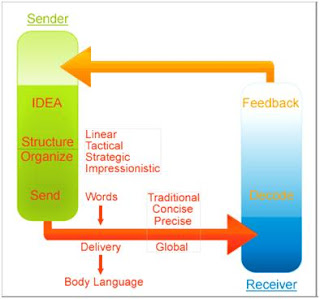
The process starts with an idea, thought or concept in the mind of the “Sender.” The “Sender” unconsciously “encodes” the message using their natural (preferred) style of organization which is then received by the “Receiver” and decoded.
1. We have found that people encode their message in a number of ways:
2. Tactical
“The art of finding and implementing means to achieve immediate or short-term goals.” Or, bettering one’s moves in the here and now. Highly contextual, this style of structuring will vary the way the information is delivered depending on a variety of factors.
“Senders” preferring this style may innately adjust the message depending on who they are speaking with. At times, the urgency of the situation may overcome a need to explain complexity and the Sender simply “nets it out.”
Strength: ability to distill vast amounts of information and give just key points.
Liability: may exclude key pieces of information that are important to the receiver.
3. Strategic
This style tends to start with the pre-determined end result and work backwards. Typically, the message begins at the end point or the macro focus, followed by the parts. The levels of abstraction from which a dialogue begins may act as a stimulus for some and a deterrent for others.
Strength: the "Receiver will always know the objective of the conversation.
Liability: the "Receiver may feel constrained and think that there is no or little room for discussion,input, or alternative points of view.
4. Impressionistic
These messages are often structured on a conceptual level. Beginning with an idea or a framework and integrating information as it comes to mind.
Strength: can inspire or engage the "Receiver."
Sending The Message
Further complicating communication is how we "send" the message. In face-to-face (analog) communication, we send messages using words, delivery and body language.
Studies show that:
In face-to-face communication we must be aware of the substantial impact that our body language, tone, pace, and volume have, as they convey nearly the entire message.
When messages are digital (email, Instant Messenger, phone text), we lose the visual and auditory cues that make up 93% of face-to-face communication.
Because IM (Instant Messaging) and phone text are more casual, with their own lexicon and typing shortcuts, e.g. LOL (laughing out loud), IMHO (in my humble opinion) BRB (be right back), OTP (on the phone), there is more forgiveness in delivery. It's also why there are emoticons (symbols to express emotion). That is not the case with email.
Having replaced the business and personal letter, and because it is so "low context" in email communication, words are 100% of the message. Delivery (tone, pace, volume) are expressed with words, punctuation, (e.g., typing in all capital letters is equivalent to shouting) and sometimes graphical images.
Word Choice
We have also found that our word choice can be delineated in four distinct patterns corresponding to our structuring style.
Traditional Word Choice
"Broadly speaking, the short words are the best, and the old words best of all." ~ Winston Churchill
This is characterized by someone who uses an appropriate name for an item or words that are common to that industry.
For example a project manager may speak about "dashboards" or "swim lanes," words that reflect norms for someone with that domain expertise. The words carry with them an inclusive or exclusionary standard. If you are part of the team or industry, understanding is easy; if you are not part of that group, they may not define terms for the layman and you are excluded from the conversation.
Concise or Colloquial
"Be amusing: never tell unkind stories; above all, never tell long ones." ~ Benjamin Disraeli
The hallmark of this style is storytelling ability using similes to drive a point home.
If in the telling of the tale the message is not received or a sense of urgency prevails, they will simply "net it out" using buzzwords, slang, or common language.
An example may be "more bang for the buck" or "she dis'd" that person. This type of word choice can create informal discussions or completely mystify a receiver if they are not familiar with these cultural or generational terms.
Precise terminology
"Be precise. A lack of precision is dangerous when the margin of error is small." ~ Donald Rumsfeld
"Senders” preferring this style often choose to use words that accurately express the nuance of what they are trying to communicate.
They may need many words to describe the abstract concept that they are trying to convey. This can sound elegant and descriptive; however, it can be perceived to be condescending and pedantic.
An example that comes to mind is a professor who was describing what he was teaching in the classroom. He stated, “We are engaged in an interdisciplinary fusion; we are re-knitting the fabric of the intellectual agenda in a way that isn’t happening anywhere else.”
Global Language
"For NASA, space is still a high priority." ~ Dan Quayle
This style is often sprinkled with words like “always,” “never,” “forever.”
Absolutes and exaggerations, while charming and many times inspiring, may cause the listener to cast doubt on the credibility of the sender.
For example, one man stated, “I never drink, but when I do…” or one young woman who excitedly exclaimed, “I’m getting married on a huge tennis court this weekend!” As she said it, someone in the class remarked, “As opposed to what? Aren’t all tennis courts the same?”
After sending the message the “Receiver” needs to “unpack” or decode the message. They do this through “the open-ended domain of interpretation.”
How does the “Sender” of the message, the one with the most vested interest in the message being received the way it was intended, gauge how the receiver is hearing it?
Conclusion
Communication skills training may merit consideration if you feel your message is not being effectively sent or received. Or, you can use these few simple techniques for more effective communication:
Most importantly adapt to the needs of your receiver. Remember we all give it the way we like it!
We all know that some people are just easier to get along with than others. Communication with them is effortless—when you talk or send them an email, they just “get it.”
And, we also know that there are some people who just don’t understand. At all. Ever.
These individuals may want volumes of detail that you don’t have, or they can be so vague you have no idea what they want, or they need to know the end result before you start, or they constantly seem to be telling everyone else what to do.
By dissecting and then understanding the critical polarities in communication that can cause conflict or misunderstanding, we can all communicate more effectively—with better results. The key is to understand your own communication “style” and then recognize and adapt to others’ styles.
The Communication Process
“When dealing with people, remember you are not dealing with creatures of logic, but creatures of emotion.” ~ Dale Carnegie
Let’s start with a graphic of the basic communication process involving two individuals (the “Sender” and the “Receiver”).

The process starts with an idea, thought or concept in the mind of the “Sender.” The “Sender” unconsciously “encodes” the message using their natural (preferred) style of organization which is then received by the “Receiver” and decoded.
1. We have found that people encode their message in a number of ways:
- Linear
- Structured sequentially, these messages typically provide the background first, then the current situation, and then the desired future state.
- Step by step
2. Tactical
“The art of finding and implementing means to achieve immediate or short-term goals.” Or, bettering one’s moves in the here and now. Highly contextual, this style of structuring will vary the way the information is delivered depending on a variety of factors.
“Senders” preferring this style may innately adjust the message depending on who they are speaking with. At times, the urgency of the situation may overcome a need to explain complexity and the Sender simply “nets it out.”
Strength: ability to distill vast amounts of information and give just key points.
Liability: may exclude key pieces of information that are important to the receiver.
3. Strategic
This style tends to start with the pre-determined end result and work backwards. Typically, the message begins at the end point or the macro focus, followed by the parts. The levels of abstraction from which a dialogue begins may act as a stimulus for some and a deterrent for others.
Strength: the "Receiver will always know the objective of the conversation.
Liability: the "Receiver may feel constrained and think that there is no or little room for discussion,input, or alternative points of view.
4. Impressionistic
These messages are often structured on a conceptual level. Beginning with an idea or a framework and integrating information as it comes to mind.
Strength: can inspire or engage the "Receiver."
Sending The Message
Further complicating communication is how we "send" the message. In face-to-face (analog) communication, we send messages using words, delivery and body language.
Studies show that:
- 55% of the message is sent non-verbally (body language)
- 38% with delivery (tone, pace, volume, and the like)
- 7% with words
In face-to-face communication we must be aware of the substantial impact that our body language, tone, pace, and volume have, as they convey nearly the entire message.
When messages are digital (email, Instant Messenger, phone text), we lose the visual and auditory cues that make up 93% of face-to-face communication.
Because IM (Instant Messaging) and phone text are more casual, with their own lexicon and typing shortcuts, e.g. LOL (laughing out loud), IMHO (in my humble opinion) BRB (be right back), OTP (on the phone), there is more forgiveness in delivery. It's also why there are emoticons (symbols to express emotion). That is not the case with email.
Having replaced the business and personal letter, and because it is so "low context" in email communication, words are 100% of the message. Delivery (tone, pace, volume) are expressed with words, punctuation, (e.g., typing in all capital letters is equivalent to shouting) and sometimes graphical images.
Word Choice
We have also found that our word choice can be delineated in four distinct patterns corresponding to our structuring style.
Traditional Word Choice
"Broadly speaking, the short words are the best, and the old words best of all." ~ Winston Churchill
This is characterized by someone who uses an appropriate name for an item or words that are common to that industry.
For example a project manager may speak about "dashboards" or "swim lanes," words that reflect norms for someone with that domain expertise. The words carry with them an inclusive or exclusionary standard. If you are part of the team or industry, understanding is easy; if you are not part of that group, they may not define terms for the layman and you are excluded from the conversation.
Concise or Colloquial
"Be amusing: never tell unkind stories; above all, never tell long ones." ~ Benjamin Disraeli
The hallmark of this style is storytelling ability using similes to drive a point home.
If in the telling of the tale the message is not received or a sense of urgency prevails, they will simply "net it out" using buzzwords, slang, or common language.
An example may be "more bang for the buck" or "she dis'd" that person. This type of word choice can create informal discussions or completely mystify a receiver if they are not familiar with these cultural or generational terms.
Precise terminology
"Be precise. A lack of precision is dangerous when the margin of error is small." ~ Donald Rumsfeld
"Senders” preferring this style often choose to use words that accurately express the nuance of what they are trying to communicate.
They may need many words to describe the abstract concept that they are trying to convey. This can sound elegant and descriptive; however, it can be perceived to be condescending and pedantic.
An example that comes to mind is a professor who was describing what he was teaching in the classroom. He stated, “We are engaged in an interdisciplinary fusion; we are re-knitting the fabric of the intellectual agenda in a way that isn’t happening anywhere else.”
Global Language
"For NASA, space is still a high priority." ~ Dan Quayle
This style is often sprinkled with words like “always,” “never,” “forever.”
Absolutes and exaggerations, while charming and many times inspiring, may cause the listener to cast doubt on the credibility of the sender.
For example, one man stated, “I never drink, but when I do…” or one young woman who excitedly exclaimed, “I’m getting married on a huge tennis court this weekend!” As she said it, someone in the class remarked, “As opposed to what? Aren’t all tennis courts the same?”
After sending the message the “Receiver” needs to “unpack” or decode the message. They do this through “the open-ended domain of interpretation.”
How does the “Sender” of the message, the one with the most vested interest in the message being received the way it was intended, gauge how the receiver is hearing it?
Conclusion
Communication skills training may merit consideration if you feel your message is not being effectively sent or received. Or, you can use these few simple techniques for more effective communication:
- Listen to how the other person structures their messages. Is it Linear, Tactical, Strategic or Impressionistic? Try to frame your message in their style.
- Listen to word choice. Is it Traditional, Colloquial, Precise or Global? Use their language. We tend to resonate and listen more closely to people who "speak our language."
- Ask yourself, what is the receiver's level of knowledge of the subject, their experience, or bias? Then tailor your message to meet their needs.
- Ask for feedback. Complete the cycle and check for understanding.
Most importantly adapt to the needs of your receiver. Remember we all give it the way we like it!
Subscribe to:
Posts (Atom)